Aduro: 86% Liquid Is the Headline. 73% Cracker-Ready Is the Story.
Why 86 percent undersells what Aduro just did, and why I think the company is a genuine standout in chemical recycling.
First, the news. On June 9, Aduro Clean Technologies reported results from the longest continuous campaign yet at its NGP pilot plant in London, Ontario. Running on recovered polypropylene, the plant ran continuously for 47 hours, held steady state for about 35 of them, and re-established steady state in roughly two hours after the team deliberately disturbed it. About 86 percent of the polypropylene returned as liquid hydrocarbon; about 85 percent of that liquid fell within the naphtha cracker range at C20 and below, and product quality was consistent with the company’s earlier batch and R2 testing.
That is the news, and you can read a version of it on any wire or aggregator within the hour, so I am not going to spend this piece re-reporting it. What follows is my opinion as a shareholder, and it is the part you cannot get just anywhere: why that 86 percent is worth far more than it sounds on the surface, and why I think Aduro is a genuine standout in this industry. The short version is that the number everyone quotes isn’t the one that matters. Once you see why, the rest gets a lot more interesting.
It ran as a system
If you remember one thing from all of this, do not make it the 86 percent. The whole plant ran as one integrated, continuous, self-correcting system, and that is the milestone that separates a promising chemistry from a business. Making a reaction work in a beaker is one problem, and Aduro solved that one years ago. The chemistry was never really the open question. The real question now is the harder one. Can feed handling, reaction, and product recovery all run together, continuously, staying stable hour after hour, without falling over? In the release, CEO Ofer Vicus framed the campaign as the plant performing as intended, generating the operating, yield, and product-quality data the company needs to set its scale-up parameters.
Think of the difference between a recipe that works once in your kitchen and the same recipe running in a commercial kitchen all day, every plate identical. The second one is the harder problem, and it is the one that feeds a business. Thirty-five hours of stable, continuous, integrated operation is the number I would circle.
(Below is my video covering the news if you prefer, but it doesn’t cover the comparison)
https://www.youtube.com/watch?v=l1j5FMYu9NA
The stress test
My favorite detail is that the team did not simply let the plant hum along and call it a win. They deliberately disturbed it, and it recovered steady state in about two hours. That tells you the process is not fragile. It is not a house of cards that only holds when every variable is perfect. For anyone thinking about scaling this toward a commercial plant, that kind of robustness is exactly what you want to see.
The scale-up held
R2 was Aduro’s earlier continuous-flow reactor, at a smaller throughput. The NGP pilot plant is the step up, bigger, more integrated, closer to a real plant. The question that decides everything at this stage is whether results hold when you scale up, because that is exactly where promising technologies quietly die. Per the release, Aduro ran chemical analysis on the NGP product and compared it against earlier batch testing and R2 at smaller throughput, and product quality came out consistent with that prior work. The company moved to a bigger, more complex plant and the quality held. That is the opposite of the usual scale-up story, and de-risking scale-up is the entire game right now.
So that is the exciting part. Now the machinery.
Start with what pyrolysis actually delivers
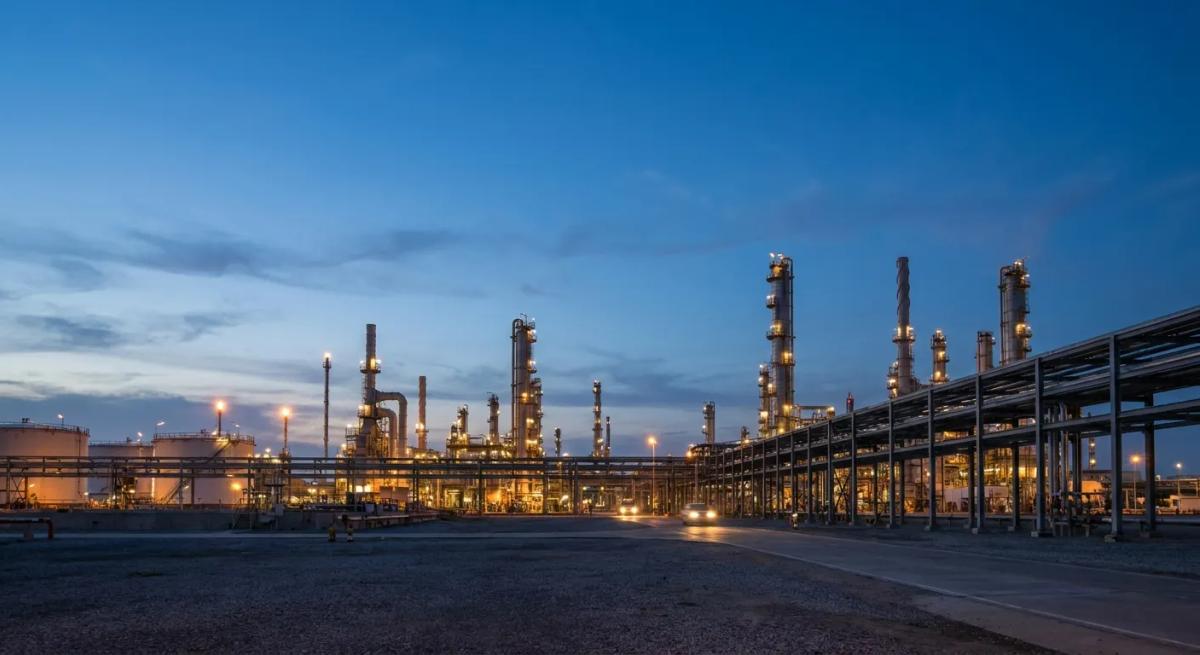
To see why Aduro’s 86 percent is worth more than 86 percent, you have to start with what pyrolysis, the incumbent approach, actually delivers, not the best case anyone imagines for it.
Pyrolysis liquid yields are genuinely high. Industrial data for polyolefins puts oil yields at about 72 to 81 percent, so the problem was never how much liquid pyrolysis produces. The problem is what that liquid is. Liquid is not the same as naphtha a cracker will take to make new plastic. In techno-economic studies of mixed polyolefin pyrolysis, the naphtha fraction is closer to 40 percent, with roughly a third of the output as heavier wax that needs to be further broken down and a slice of light gas that typically gets burned in the plant for process heat.
The oil that remains is the bigger issue. Pyrolysis breaks plastic down thermally through random scission at high temperatures, yielding a broad mixture that tends to be heavy in aromatics or olefins and to carry contaminants such as chlorine, nitrogen, and metals from the waste stream. Steam crackers have strict limits on exactly those things, because olefins promote coking and fouling, and chlorine is corrosive. So the oil generally has to be upgraded, most often by hydrotreatment, before a cracker will accept it. In one peer-reviewed steam-cracking study, hydrotreatment had to cut the olefin content from around 51 percent down to about 8 percent before the oil performed well. That upgrading is a real cost, real complexity, and more lost mass.
And there is a last twist that critics and investigative reporting have pressed hard on. Because the upgraded oil is usually blended into a much larger stream of fossil naphtha, the recycled material that physically ends up in the new plastic can be small, with mass-balance accounting doing the work of assigning the recycled claim. Industry disputes how that should be framed, but the underlying point is hard to argue with: a pyrolysis plant can report a large liquid yield and still deliver a much smaller slice of genuinely cracker-ready, new-plastic-bound material.
Now the unicorn
Now grant pyrolysis a unicorn. Imagine a pyrolysis plant that somehow matched Aduro and hit 86 percent liquid yield. It still would not be the same plant, because that liquid would have to clear the same gauntlet, the naphtha-versus-wax split, the hydrotreating, the contaminant removal, the fuel-versus-plastic question. The headline would match. The usable, new-plastic-bound output would not.
Why Aduro’s 86 percent is worth more than 86 percent
Here is the contrast that matters. Aduro reported that about 85 percent of its liquid fell at C20 and below, the cracker feedstock range. Combine that with the 86 percent liquid yield and roughly 73 percent of the original polypropylene lands in that cracker-ready range. Set that next to a representative pyrolysis naphtha fraction nearer 40 percent and the gap is plain, similar liquid yields, very different amounts of the material a cracker actually wants for new plastic. I am not going to reduce that to a single multiplier, because pyrolysis varies a lot by process and conditions, but the direction is not subtle. That is what better than 86 percent means. The same headline number, carrying a much larger share of usable, low-olefin, fungible, new-plastic-bound product. And as the rules below show, new-plastic-bound is the only kind that counts.
One number to keep honest while we are here: that 85 percent is 85 percent of the liquid, not of the plastic. The roughly 73 percent figure is the two combined. Worth saying plainly, because it is easy to round up by accident.
Thanks for reading Penny Queen’s Newsletter! This post is public so feel free to share it.
The chemistry that makes it cracker-ready
Why does Aduro’s product come out so much closer to cracker-ready? Because the process is a different category, not just a different score. Hydrochemolytic technology is water-based and runs at relatively low temperature, and a core design goal, evaluated during Aduro’s Shell GameChanger work, is suppressing olefin formation in the first place. Olefins are exactly what force much of the upgrading burden onto pyrolysis oil. Suppress them at the source and you avoid much of the hydrotreating that pyrolysis cannot. Aduro has a phrase for this. They call it the chemistry in between, and this campaign is really just data backing up what they have been saying all along. The pitch is not that they make more liquid. It is that they make a cleaner, more consistent liquid that is closer to cracker-ready as it comes out.
Fungibility
That word, fungibility, is not one I am inventing. A fungible product is interchangeable, one unit substitutes cleanly for another, the way a barrel of one suitable crude can stand in for another at a refinery. Aduro describes its output as a fungible hydrocarbon product, feedstock for circular production of plastics. To me it just means sellable. To picture what that means, it helps to see where a barrel of HCT product actually goes.
**A note before this chart: this is R2, not the NGP campaign.** I am including it because it is the clearest picture of how Hydrochemolytic technology splits a feedstock into products. But every number in it comes from Aduro’s earlier R2 continuous-flow work, not the June pilot plant campaign this article is about. Read it as a map of how the process works, not as a restatement of the new results.
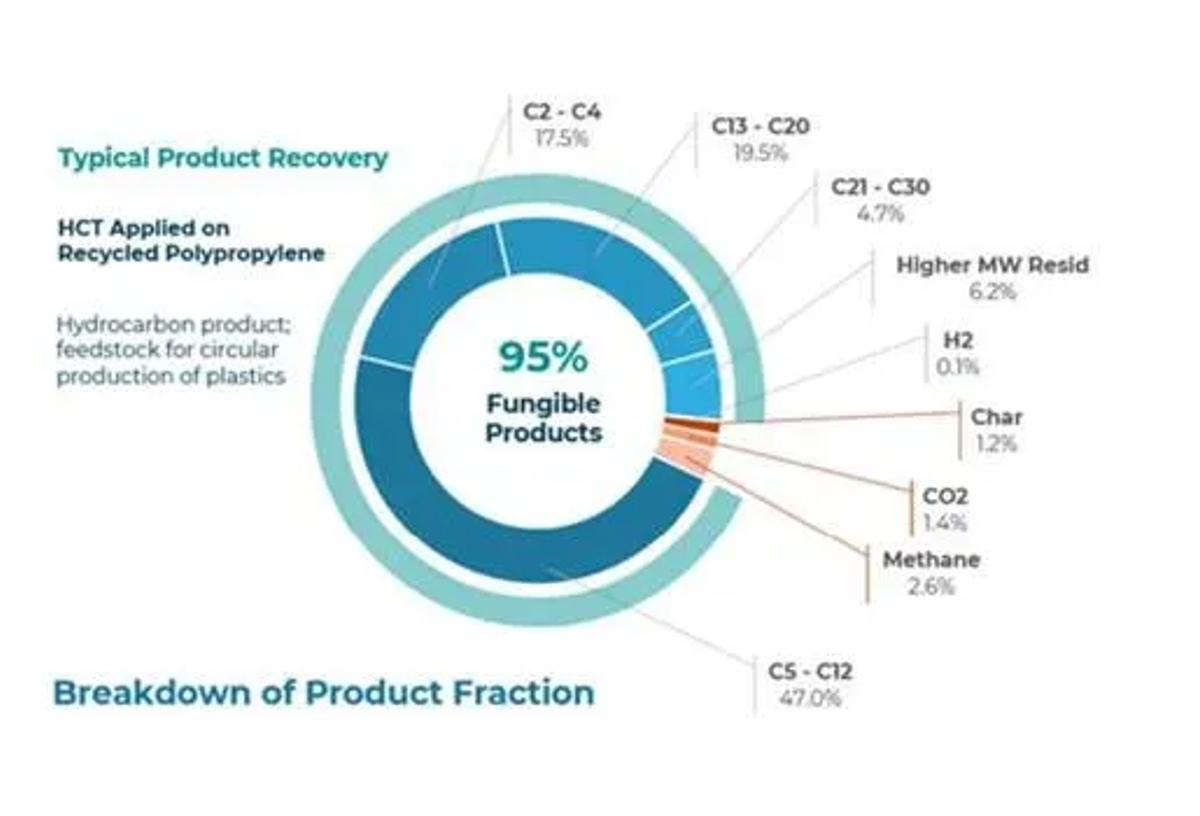
*Source: Aduro, typical product recovery for HCT applied on recycled polypropylene, from the earlier R2 continuous-flow stage. Shown to illustrate the product slate, not the NGP results. One metric to keep straight: the 95 percent in the center is fungible products, meaning the liquids plus the valuable light gases, the C2 to C4 slice, and hydrogen. That is a more descriptive measure than the NGP campaign’s 86 percent liquid hydrocarbon. The roughly 5 percent that was not fungible is the char, carbon dioxide, and methane.*
The shape is the point. Most of the output lands in useful ranges, with very little going to char, carbon dioxide, and methane.
Green credits
Here is where the chemistry turns into money. From January 2030, the EU’s Packaging and Packaging Waste Regulation requires plastic packaging to contain a minimum post-consumer recycled content, starting at 10 to 35 percent and rising toward 65 percent by 2040, and only genuine post-consumer recyclate counts. For contact-sensitive plastics other than PET, chemical recycling is currently the only proven path to that recycled content. Chemical recycling is credited through mass balance, and here is the part that matters most. The EU has adopted a fuel- excluded approach, meaning material that ends up as fuel or for energy recovery does not count as recycled content. Only material that goes back into new plastic does.
Sit with what that means next to everything above. The prize is not making oil. The prize is making material that re-enters plastic production and can therefore claim recycled-content value under a mandate that is about to bind. A contaminated oil that needs heavy upgrading and often ends up blended toward fuel sits on the wrong side of that line. A clean, low-olefin, cracker-ready, fungible feedstock that drops back into polymer production sits on the right. It is also, neatly, the answer to the recycling critique. The thing critics say pyrolysis lacks, genuinely new-plastic-bound material, is exactly what these rules reward. A fair caution: mass balance accounting is contested, and exactly how the fuel-use-excluded rule lands across all of PPWR is still being worked out, so treat this as the direction of travel rather than a settled credit you can bank today.
Why bigger players should pay attention
Now you can see why that C20 detail matters. A product in the cracker feedstock range does not ask the world to build a brand-new parallel system to absorb it. It is designed to slot into the petrochemical infrastructure that already runs today, and under the coming rules, the version of it that re-enters the plastics market is the one that carries regulatory value. So, picture who reads a release like this closely. The people who operate crackers, the people who need a reliable and consistent feedstock, the people who fund first-of-a-kind plants. For that audience, the signal is not the 86 percent. The signal is continuous, steady-state, and integrated, with product quality maintained through scale-up. That is the kind of data that moves a conversation from interesting to serious. I am not putting a number on what that is worth, and I am not predicting anyone does anything. I am describing the kind of validation this is, and who tends to care.
What I am watching next
The company’s stated near-term focus is moving from the 24/4 model toward sustained 24/7 operation, then running mixed feedstocks, polypropylene and polyethylene together, because real-world waste is never one clean plastic. That mixed-feedstock data is the milestone I am watching most closely. All of it feeds the design basis for Aduro’s planned first-of-a-kind plant, and it lands at a meaningful moment. Just days earlier, on June 3, Aduro named Jan Lemmens to lead FOAK project delivery at Chemelot. This is not data going into a drawer. It is data flowing into the plant the company is now preparing to engineer and build.
The chemistry was never really the question. Whether Aduro could run it as a real, continuous, scalable process was. This campaign is a strong answer.
Created with TradingView
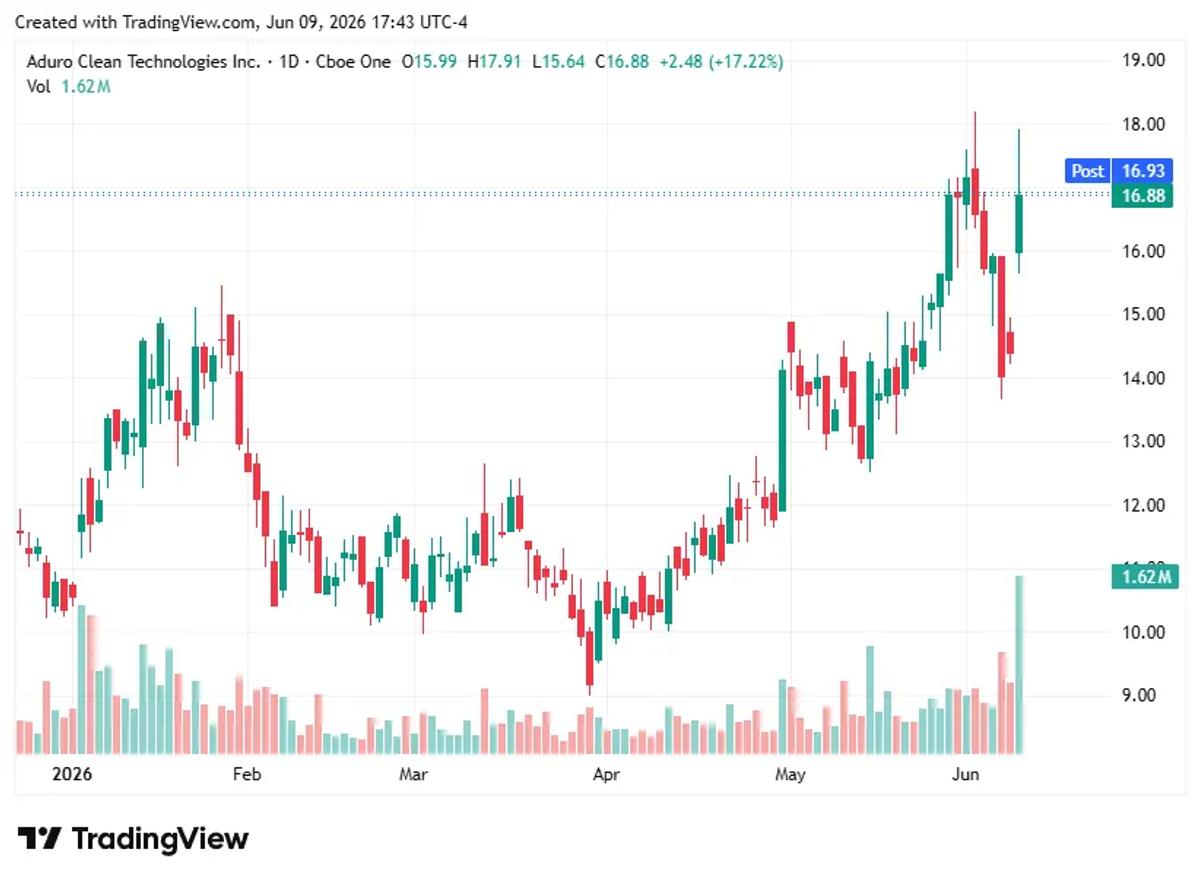
The chart, and this part is my read, not advice
Everything above is the why. This part is the where, and I want to be honest that it changes gears. The fundamentals above are sourced fact. What follows is my read of the chart, which is opinion and technical analysis, not a prediction and not financial advice. On June 1st, Aduro hit a new all-time high of $18.19, the prior all-time high had been $17.66. It then pulled back as is typical, but was also hit by the broader market’s sell off. The NGP news pushed it up again to $17.91 before the market wobbled again. This up and down movement has us solidifying this zone. Today was the highest dollar amount ever traded by Aduro. $1.623 million shares and 26.5m dollars worth.
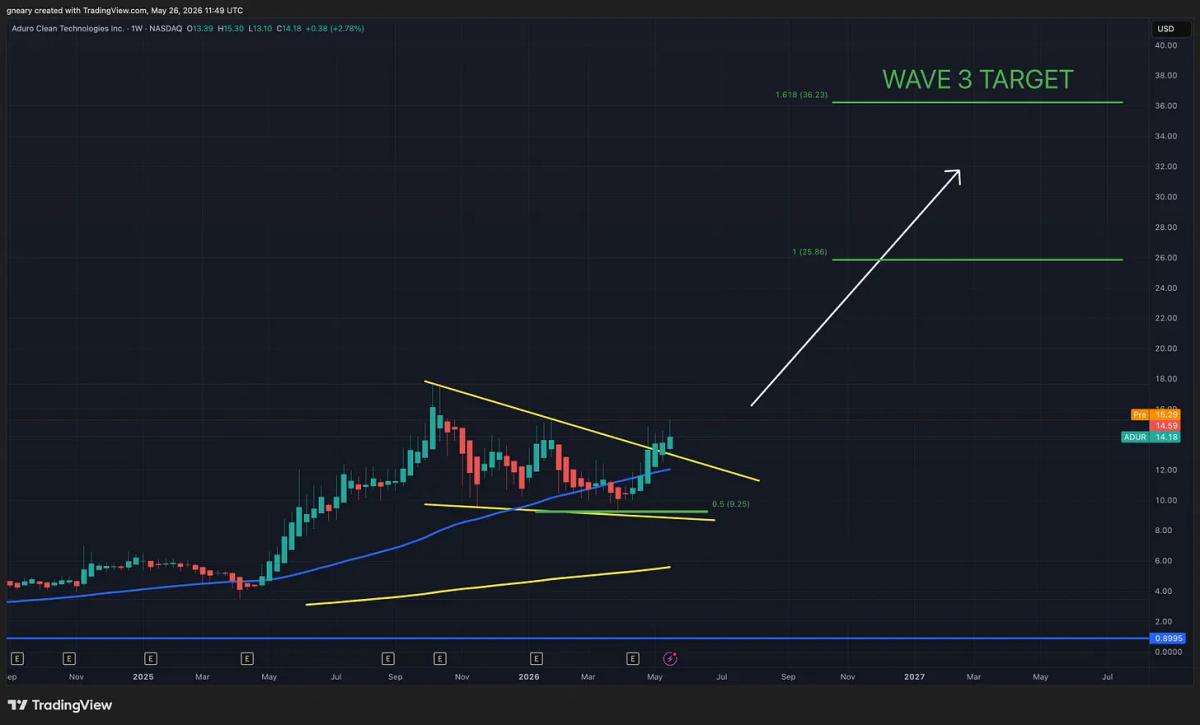
Here is what I see. ADUR spent months building a base and has been pushing up off it, and on this news, it broke out with real volume behind it. On my Fibonacci extension the levels I am watching sit around $26 and then $36 if the move has the legs to carry that far. I am not telling you it gets there. The chart can roll over, or chop sideways, or do something none of us expects. Fibonacci levels are not magic. They are just where I watch for the next decision. But I will say plainly that I am excited about the possibility, and the reason I am excited is everything in the first two thirds of this article. A chart only matters if the story underneath it is real, and this story just got more real. The following chart was created by Gneary on May 26th and posted by The Long Investor; the current movement has no impact on the Fibs other than a bit of confirmation.
Sources
Aduro Clean Technologies
- Shell GameChanger program graduation, December 2025 (olefin suppression and liquid hydrocarbon selectivity)
- March 2026 Corporate Presentation (R1, R2, NGP, FOAK scaling ladder; the R2 product-recovery chart)
Pyrolysis yields, product quality, and upgrading
- Industrial pyrolysis oil yields, 72 to 81 percent (review, 2024): https://www.sciencedirect.com/science/article/pii/S0165237024001347
- Naphtha, wax, and gas split for mixed-polyolefin pyrolysis (techno-economic, 2022): https://www.sciencedirect.com/science/article/abs/pii/S0959652622051162
- Pyrolysis oil composition and steam-cracker specifications, Kusenberg et al., Waste Management (2022): https://www.sciencedirect.com/science/article/abs/pii/S0956053X2200040X
- Hydrotreatment and steam-cracking of pyrolysis oil, olefins cut from about 51 to 8 percent (2025): https://www.sciencedirect.com/science/article/abs/pii/S0165237025000038
- Upgrading requirements for cracker-compatible pyrolysis oil, Waste Management (2025): https://www.sciencedirect.com/science/article/pii/S0956053X25006981
- Plastic waste contaminants and steam cracking, AIChE: https://www.aiche.org/conferences/videos/conference-presentations/plastic-waste-contaminants-deal-breaker-steam-cracking
- Pyrolysis waxes, fuel gas, and aromatics, C&EN (2022): https://cen.acs.org/environment/recycling/Amid-controversy-industry-goes-plastics-pyrolysis/100/i36
- Critical view on real recycled content and mass balance, CT Mirror (2024): https://ctmirror.org/2024/06/26/plastic-recycling-pyrolysis/
EU PPWR and chemical-recycling credit
- PPWR recycled content targets, TOMRA: https://www.tomra.com/about-tomra/circular-economy/ppwr-eu-packaging-regulation
- PPWR post-consumer recyclate and mass balance: https://www.getsunhat.com/blog/ppwr-recycled-content-targets-pcr-requirements
- EU fuel-use-excluded approach for chemically recycled content, S&P Global (February 2026): https://www.spglobal.com/energy/en/news-research/latest-news/chemicals/020926-eu-approves-targets-for-chemical-recycling-content-for-plastic-bottles
Disclosure: I am a shareholder of Aduro Clean Technologies (Nasdaq: ADUR / TSX: ACT) and have held shares since the IPO. This article is for educational and informational purposes only and is not financial advice. Every factual claim above traces to the public sources listed. Always do your own due diligence.
This article reflects personal research and opinions and is provided for informational purposes only. It is not financial advice, a recommendation to buy or sell any security, or a consideration of your individual circumstances. Investing in small-cap and pre-commercialization companies involves significant risk, including the risk of total loss. Always do your own research and consider speaking with a qualified financial professional before making investment decisions.
Stay Informed with The Wire
Get the latest insights and analysis on public companies delivered directly to your inbox.