One Polymer, One Plant, $1.6 Billion
What PureCycle's Q2 tells you about what Aduro is worth
PureCycle Technologies reported Q2 2026 this morning. The market values that business at roughly $1.6 billion in enterprise value.
Aduro Clean Technologies has roughly $410 million in assets.
The reflexive response to that gap is “Well, PureCycle has revenue.” I want to take that response seriously and then show you why it doesn’t stand up to the numbers.
This is not a hit piece. PureCycle just put commercial recycled resin into a Procter & Gamble consumer product, which is technically hard, and the team deserves credit. But there is a difference between proving a product existsand proving a business works, and the market is currently pricing PureCycle as though it has done both.
1. What PureCycle Reported
Operational:
- First P&G commercial resin deliveries began; select Downy detergent caps are now in commercial production
- Revenue of $4.5 million, up ~173% year over year, a sixth consecutive quarter of sequential growth
- New Jersey DEP approved PureFive resin as post-consumer recycled content
- On-site compounding is now operating
- Initial PureFive shipments in Q3 to all three major converters for QSR cold cup trials
Financial:
- Net loss of $(142.2)M vs. $(144.2)M in Q2 2025
- Operating loss improved to $(41.3)M from $(45.6)M
- Adjusted EBITDA of $(31.7)M vs. $(27.8)M
- Total liquidity of $236.9M
- Core operations spending of $8.3M/month, down ~8% from $9.0M
- Materials spending of $2.1M/month, up from $0.7M/month in Q1
- A non-recurring legal settlement of $20.4M in cash
Give real credit for two items. The New Jersey approval converts PureFive from a product into a compliance instrument under a state mandate beginning in 2027, creating a genuine moat. And core monthly spend came down while production grew ~32% year over year through a planned turnaround. That is competent operating management.
Now let’s look at what it adds up to.
2. Skip the $142 Million
A lot of commentary will lead with the net loss headline. Don’t — it’s the weakest number in the release, and using it will get you correctly dismantled.
The $142.2M is dominated by non-operating, largely non-cash items; the same pattern produced a $144.2M net loss in Q2 2025, compared with a $45.6M operating loss. PureCycle says so directly: the year-over-year adjusted EBITDA comparison reflects roughly $7.8 million of lower non-cash add-backs rather than any deterioration in operating performance.
The number that actually matters:
- ~$31.7M/quarter negative adjusted EBITDA
- ~$8.3M/month core operations plus ~$2.1M/month materials
- $39–45M guided FY2026 project spend
Call it $150M+ of annual cash consumption against ~$18M of annualized revenue.
3. The Utilization Problem
This is where “but they have revenue” breaks.
Ironton’s nameplate capacity is 107 million pounds per year (~48,500 tonnes). Management has publicly estimated cash production costs at roughly $0.50–0.60 per pound.
Run the coverage math. Core operations spending is $8.3M/month (~$100M per year) and excludes materials. To cover corporate operating cash spend alone, the contribution margin has to clear $100M:
Required contribution: ~$100M At 107M lbs (100% of nameplate): need ~$0.93/lb of margin At $0.55/lb cash cost: need a realized price of ~$1.48/lb
That is the breakeven case. At full nameplate, at a premium realized price, PureCycle roughly covers operating spend — and has contributed nothing toward $438M of debt, nothing toward $39–45M of annual project spend, and nothing toward a return on the $360–365 million already sunk into the facility.
Drop to 80% utilization, and contribution falls to roughly $77M against $100M of spend. Still negative. The intuition that they need ~80% is conservative: the real bar is closer to 100% at premium pricing, and even then, it only reaches operating breakeven.
Where is utilization today? Q1 2026 was a record quarter, with approximately 10 million pounds of feedstock throughput, roughly 37% of nameplate throughput on an annualized basis. On resin actually produced, disclosed volumes have run lower. And on the metric that pays the bills, resin sold, $4.5M of quarterly revenue implies something in the neighbourhood of 15% of nameplate, depending on your assumption for realized pricing.
(Realized price per pound is my estimate; PureCycle does not disclose it directly. Substitute your own; the shape of the conclusion holds across any plausible range.)
And here is the detail that should give you pause: materials spending tripled from $0.7M/month to $2.1M/month as production restarted. Cost is scaling faster than revenue.
Revenue growing 173% sounds like de-risking. Revenue growing while the cost of producing it grows faster, at ~15% utilization, against a $438M debt stack, is something else. It proves the product ships. It does not prove the unit economics work. Those are different claims, and only the first has been demonstrated.
4. What a Pound of Capacity Costs
Ironton costs approximately $360–365 million for 107 million pounds of annual capacity, roughly $7,400 per tonne of installed capacity.
PureCycle’s own CEO has publicly acknowledged the inefficiency, contrasting the Ironton greenfield build with an estimate that a 130-million-pound line in Thailand could be built for “250-ish” by siting it at an integrated petrochemical complex rather than a greenfield. That is management telling you the flagship asset was capital-inefficient.
Aduro’s Chemelot FOAK is estimated by Roth at $50 million to reach 25,000 tonnes, about $2,000 per tonne. Water Tower Research models it higher (~US$39M for the initial FOAK plus shared site infrastructure, plus ~US$35M for the +15kt Phase 2), landing closer to $3,000 per tonne.
Somewhere between 2.5x and 3.7x less capital per tonne of capacity.
Two caveats, stated plainly rather than buried:
- Ironton’s number is the money spent. Aduro’s is money projected.First-of-a-kind projects overrun. If Chemelot comes in at 1.5x budget, the advantage narrows materially.
- The products differ. Ironton makes purified resin sold into the PP market. Chemelot will produce circular naphtha for sale into the petrochemical feedstock chain. Revenue per tonne differs, so capital-per-tonne is incomplete on its own.
The structural point survives both. Aduro is sitting at an existing integrated chemical park, precisely the strategy PureCycle’s CEO now says he’d prefer, and Aduro’s model transitions to licensing, where someone else’s balance sheet funds the next plant. PureCycle must build every incremental pound itself.
5. Where $30 Million Went
To push $216M of debt from a 2030 maturity to a 2032 maturity at a lower coupon, PureCycle paid approximately $246.3 million in cash in June 2026. Roughly a $30 million premium, real money, permanently gone, buying two years of runway on the maturity wall and nothing else.
The concurrent equity is trading at $8.21, down from a 52-week high of $17.37. The new 4.75% notes convert to around $11.08. The stock closed yesterday near $6.87, some 38% below the conversion price. Short interest was above 40% as of March 31.
Total consolidated indebtedness was $403.8M at March 31, 2026. Pro forma for the $250M issuance, it would have been $653.8M; net of the ~$216M repurchase, the stack lands around ~$438M, plus Series A preferred sitting ahead of common.
(Reconcile against the Q2 10-Q when it posts; I’m working from the Q1 filing plus the June offering documents.)
Contrast Aduro’s June 2026 raises: US$15.54M at US$15.20 and C$9.15M at C$21.20, with insider participation and no warrants attached. No convertibles, no ATM, no floorless instruments, no debt. Total debt of C$0.1 million, functionally zero.
Roth models an additional $50–60M of equity issuance through 2030. Aduro shareholders will be diluted; I’d rather say that than pretend otherwise. But there is a real difference between equity raised at rising, milestone-linked prices and cash paid at a premium to refinance a maturity wall. One fund’s progress. The other fund’s time.
6. The Scope Asymmetry
This is what I think the market isn’t pricing at all.
What PureCycle is
One polymer. Polypropylene. Not PE, not PS, not mixed streams, not multilayer flexibles. PP is a large market, but it's a one-lane road.
One mechanism. Solvent dissolution, a purification process. It removes colour, odour, and contaminants. It does not break carbon–carbon bonds. It cannot make naphtha, cannot feed a steam cracker, and cannot convert a polymer into anything other than a cleaner version of itself. Functionally, a very sophisticated washing machine for plastic.
Licensed IP. The process was developed by Procter & Gamble; PureCycle operates under license, and its own risk factors flag reliance on P&G-licensed technology. Whatever you think of the process, the invention is not the company’s.
One product, one market. Purified PP resin competes against virgin PP on price. When virgin PP is cheap, the spread compresses. Realized pricing is structurally tethered to a commodity that PureCycle does not control.
Feedstock-constrained. Dissolution needs to be sorted, reasonably clean PP. The hardest, dirtiest, most abundant fraction of the waste stream, the material that actually carries negative value, is not addressable.
One plant. Every incremental pound requires another balance sheet event.
What Aduro is
Three polymers, plus contamination tolerance. PE, PP, and PS together account for more than 70% of municipal plastic waste, precisely the streams that mechanical recycling cannot reach. Aduro’s November 2025 disclosure describes steam cracker trials in which HCT oil derived from mixed waste plastic, including PE, PP, PS, PET, and polyamide, was processed as-produced, without dilution or pre-treatment, at an established European pilot facility, with a stated boiling range substantially lower than that of comparable chemical recycling oils.
Read that against the section above. PureCycle needs the clean sorted fraction. Aduro’s stated target is the fraction nobody else wants.
Three verticals off one chemistry. Plastic upcycling is one application. Paraffinic and heavy crude upgrading is a second CIP patent filing, a dedicated program director hired in May, Utah Petroleum Association membership, and Uinta Basin feedstock secured in June. Renewables upgrading to aromatics and SAF is a third. Roth already carries paraffinic crude royalties from 2030 at ~95% gross margin. Management has indicated the paraffinic crude application requires its own separate pilot, treat commercial timelines, which are unconfirmed.
Every vertical shares the same R&D base. The marginal cost of the second and third applications is a fraction of the first. A single-polymer purification company structurally cannot replicate that, because dissolution does one thing to one material.
Owned IP. Eleven patents, seven granted, four pending, covering core chemistry and process integration, in a field historically dominated by ConocoPhillips, Shell and Total.
A feedstock, not a resin. Circular naphtha sells into the petrochemical value chain, not the PP resin market. Different buyers, different pricing dynamics, and a product that steam crackers can take directly, rather than a resin competing head-to-head with virgin pellets.
A licensing endgame. Build-own-operate the FOAK to prove the numbers, then license. Royalty revenue at ~95% gross margin, per Roth. The capital intensity that defines PureCycle’s entire story is exactly what Aduro’s model is designed to hand to somebody else.
No debt. 34% insider ownership. The founder has never sold.
Four independent sell-side firms cover the name with Buy ratings, D. Boral ($46), Roth ($30, initiated July 27), Ladenburg Thalmann (C$24.75), H.C. Wainwright ($22). Water Tower Research also publishes on Aduro; that is paid IR coverage and should be weighted separately from independent sell-side.
7. The Enterprise Value Bridge
Market cap is the wrong lens when capital structures diverge this hard.
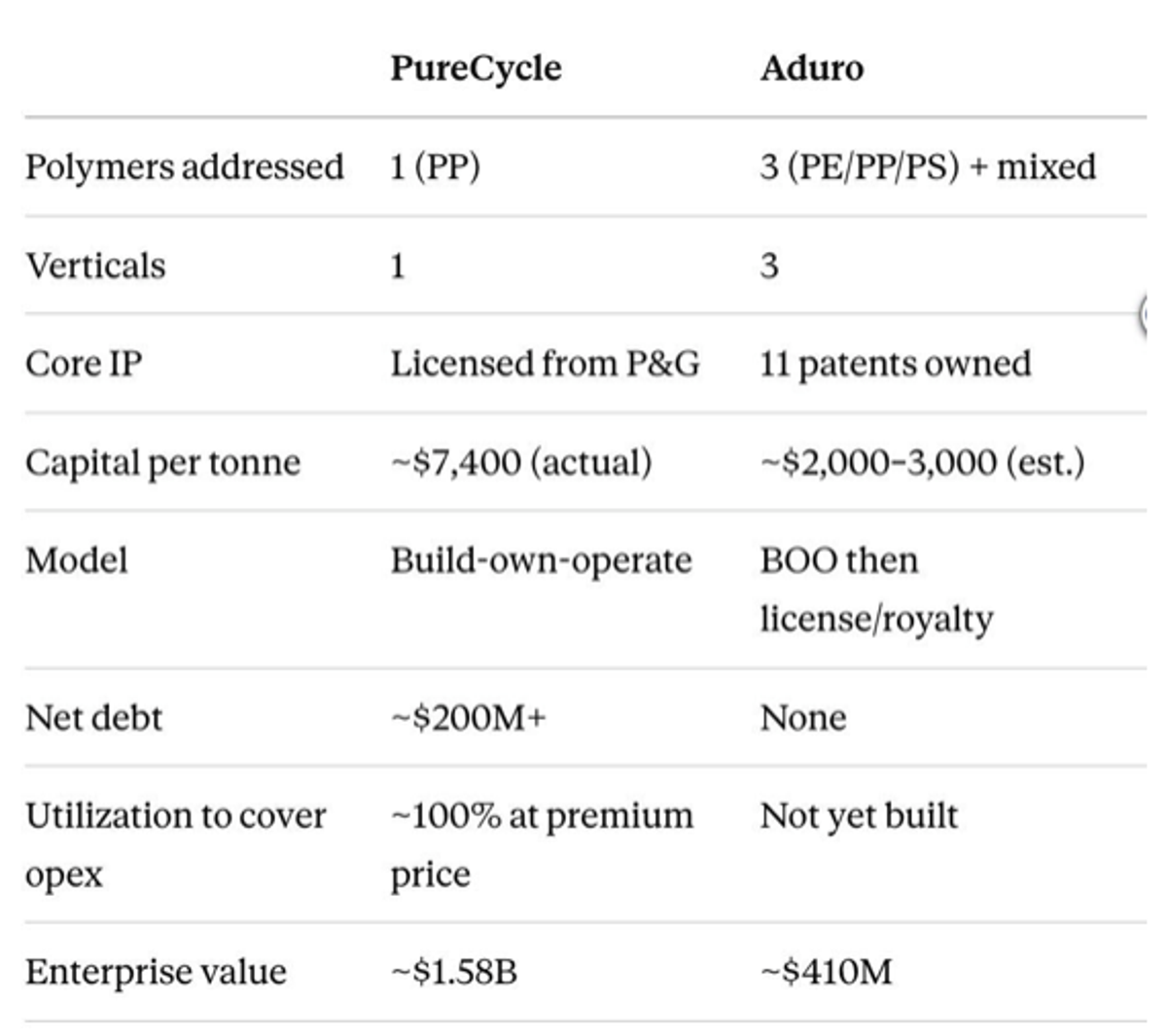
PureCycle: ~$1.38B equity (≈200M shares near $6.87) + ~$438M debt − $237M liquidity ≈ ~$1.58B, before considering preferred.
Aduro: ~$460M equity (~33.7M shares near $13) − ~$50.6M cash (Roth’s post-June estimate) ≈ ~$410M.
A ratio of roughly 3.9x, and it holds better on EV than on market cap because EV captures the debt.
Per dollar of enterprise value, you’re choosing between:
8. What I Still Have to Answer
I’m long and biased, so let me make the case against myself rather than wait for someone else to.
Ironton’s struggle is a warning about Chemelot, not just about PureCycle. This is the one that matters, and I won’t have it both ways. If I use PureCycle’s utilization problem as evidence against them, I have to concede Aduro has never operated anything larger than a 10 kg/hr pilot. The ~86% liquid yield, the 47-hour continuous run, the ~85% at C20-and-below, that is pilot data from a single campaign. Ironton was going to hit the nameplate, too. Everything above about capital efficiency and licensing economics is contingent on a plant that doesn’t exist yet performing as well as a pilot did. If Chemelot has an Ironton-style ramp, this thesis is wrong, and the discount was correct.
“X is overvalued” does not prove “Y is undervalued.” Both can be mispriced in the same direction. If the market sours on advanced recycling as a category, PureCycle compresses, and Aduro doesn’t automatically expand.
Regulatory definitions could cut against conversion. If PCR-content rules continue to favour purification pathways over molecular conversion, that’s a structural headwind Aduro needs ISCC PLUS mass-balance certification to address. Watch the Delphi LCA.
I hold my position knowing all of this.
9. So What Is the Claim?
Not “Aduro should be worth $1.6 billion tomorrow.” That’s lazy, and it isn’t what I think.
The claim is this:
The market has demonstrated it will underwrite advanced recycling at $1.6 billion of enterprise value for a business that is one polymer, one mechanism, one plant, licensed IP, $438M of debt, and roughly 15% utilization, where full nameplate at premium pricing gets you to approximately operating breakeven, before debt service.
That is the revealed price of the category. It isn’t hypothetical; it was printed today.
Against that benchmark, a debt-free platform addressing three polymers across three verticals on owned IP, with a capital intensity per tonne of a quarter to a third of PureCycle's, and a licensing model designed to avoid PureCycle’s exact problem, trades at one-quarter of the enterprise value.
The gap I’m underwriting isn’t “PureCycle is wrong.” It’s that the execution discount applied to Aduro is wider than the category premium it earns if Chemelot works. That’s the trade, and it lives or dies on one plant in Sittard-Geleen.
10. What Would Change My Mind
- Scale-up failure at the FOAK. If Chemelot can’t reproduce pilot yields at 10,000 t/yr, there is nothing to license.
- No commercial license signed by the end of 2028. The whole thesis is that partners will pay for this.
- Repeated dilutive raises at falling prices. Capital discipline is a core reason I own this.
- FOAK capex overrun beyond ~2x. The capital-efficiency argument is the load-bearing wall of this piece. If it goes, so does the piece.
11. What to Watch
- Aduro’s consolidated NGP validation data package (Q4 2026 window)
- Chemelot permitting via Ebert HERA
- Offtake LOI Phase 1 sample qualification converting to a Phase 2 FOAK parcel commitment
- Naming of the EPC MOU counterparty
- Formal HBU / paraffinic crude pilot announcement
- Delphi LCA and ISCC PLUS certification progress
- PureCycle Q3: whether the P&G ramp moves utilization meaningfully off ~15%, and what materials cost per pound does as it goes
Figures are drawn from PureCycle’s Q2 2026 press release, its June 2026 offering documents and Q1 10-Q, public management commentary on Ironton capacity and cash costs, Aduro’s corporate disclosure, and Roth Capital Partners’ July 27, 2026, initiation. Realized pricing and utilization percentages are my estimates, where PureCycle does not disclose directly, and are labelled as such. Market data as of August 5–6, 2026. Verify against primary filings on SEDAR+ and EDGAR before acting on any of it.
This is not financial advice. I own shares of $ADUR, which represent ~30% of my equity portfolio, so I am biased. Long $ADUR | Not financial advice | DYOR.
This article reflects personal research and opinions and is provided for informational purposes only. It is not financial advice, a recommendation to buy or sell any security, or a consideration of your individual circumstances. Investing in small-cap and pre-commercialization companies involves significant risk, including the risk of total loss. Always do your own research and consider speaking with a qualified financial professional before making investment decisions.
Stay Informed with The Wire
Get the latest insights and analysis on public companies delivered directly to your inbox.