Aduro’s Beta, the Steam-Cracker Mic Drop, and Why a $19 Target Misses the Point
A new update on Aduro Clean Technologies reveals its recycled-plastic–derived “Hydrochemolytic™ oil” passed pilot-scale steam-cracker tests in October 2025. The oil — made from mixed plastic waste — was cracked “as is,” with no pre-treatment or dilution, showing furnace performance and yields of ethylene and propylene comparable to traditional fossil feedstock. This milestone suggests Aduro's process could feed existing petrochemical infrastructure directly — vastly lowering complexity, costs, and environmental impact, and helping turn mixed plastic waste into new, “circular” plastics.
This is a long one.
1. Living With a High-Beta Monster
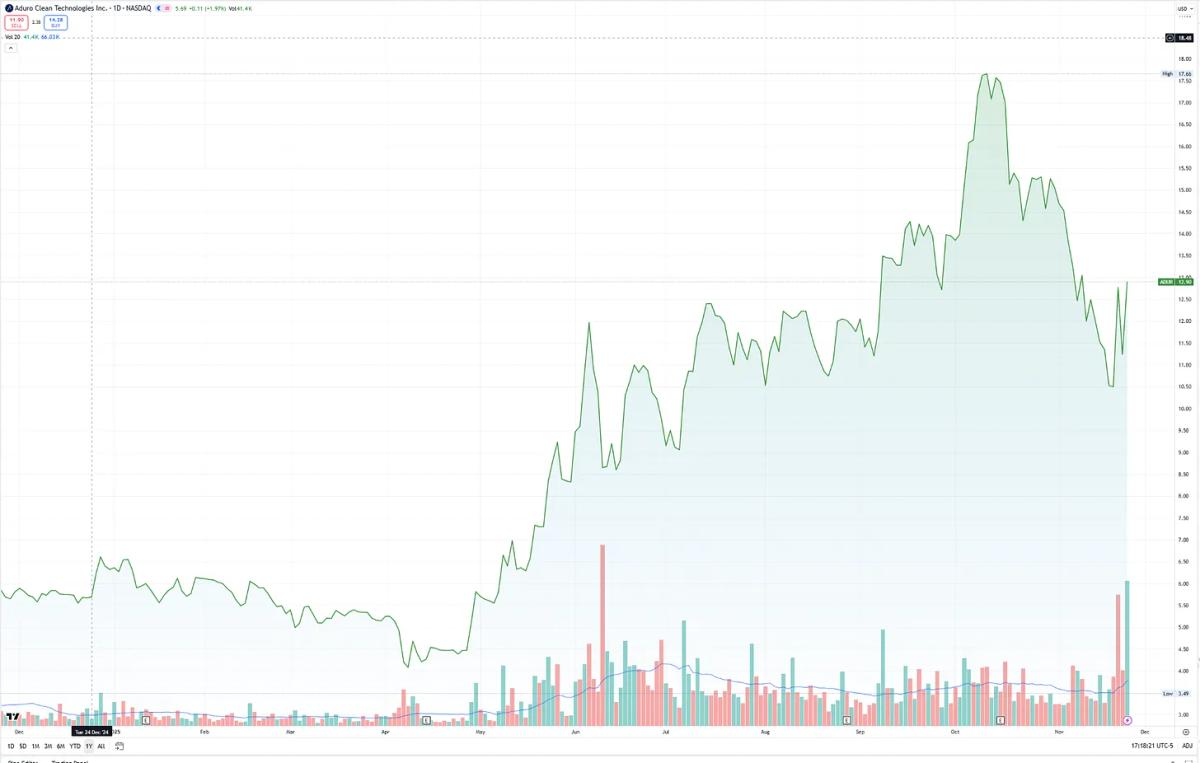
Pull up Aduro’s chart and it looks less like a blue-chip stock and more like an EKG after three espresso shots.
Over the last year, this name has traded between roughly $3 and the high teens, with multiple 30-50% swings in both directions. Even Ladenburg’s own initiation report leads with a 52-week range of $3.49 to $17.66. We recently touched a low of $9.78 during the pullback before bouncing back to the $12.70 range, right around key Fibonacci support levels.
None of that volatility has anything to do with quarter-over-quarter revenue, because there basically isn’t any yet. This is what a high-beta, pre-revenue cleantech stock looks like when the market suddenly wakes up to a new technology and then tries to price 20 years of optionality in six weeks.
A few things are driving those wild swings:
Tiny effective float. A meaningful chunk of shares are in tight hands, early investors, management, long-term holders like me. That amplifies every marginal buyer or seller.
Event-driven trading. Each press release or interview that moves the probability of commercialization gets exaggerated in the price.
Options, warrants, and momentum money. Once you get on Nasdaq and start printing double-digit daily volume, every short-term strategy shows up.
Macro fears. That recent drop to $9.78? It wasn’t really about Aduro. It was about broader fears of an AI bubble sending investors fleeing from anything perceived as speculative or “future technology.” Small-cap innovation stocks across the board got hammered.
If you own Aduro, you’re not holding a sleepy utility. You’re strapped to the front of a high-beta experiment where the business is on a slow, methodical multi-year path and the stock is on a roller coaster.
I’m fine with that, because my thesis is about what this looks like once the technology is in commercial plants. To understand why, we need to talk about steam crackers.
2. Steam Crackers 101: Why This Validation Changes Everything
You can read the next section or sacrifice 9 minutes to hearing me tell you about it in this video.
What steam crackers are and why they’re so picky
If you want new plastics, you need ethylene and propylene. Those come from steam crackers: enormous, billion-dollar furnaces running around 850°C that tear hydrocarbons into smaller building blocks.
These are the crown jewels of the petrochemical world. They’re multi-billion-dollar assets operated by companies that are allergic to risk. A bad feed that causes coking or fouling can cost millions per day in lost production.
Because of that, crackers are fed very clean, very consistent fossil streams like naphtha or natural-gas liquids. Anything unstable, contaminated, or unpredictable is treated as a liability, not a feedstock.
This is exactly why most pyrolysis-based chemical recyclers have struggled. Their oils are usually full of contaminants and unstable compounds, heavy on waxes (too big) and light gases (too small), spread over a wide, messy molecular range.
So they bolt on hydrotreaters to beat the oil into compliance. That means $400-500 per tonne in extra cleanup cost, high-pressure hydrogen systems, more capex, more complexity, more things to go wrong. And even after all that, operators often insist on diluting the oil with fossil naphtha just to stabilize it.
Financially, that’s a terrible place to be: you’re paying up for clean feed, paying again to fix the product, and still throwing away yield.
What Aduro just did
Aduro’s latest announcement is the opposite of that story.
There are only four companies on Earth that license steam-cracker technology: KBR, Technip Energies, Lummus Technology, and Linde. One of them took oil made in Aduro’s Hydrochemolytic Technology process, from mixed, contaminated post-consumer plastics including HDPE, LDPE, PP, PS, with small amounts of PET and polyamide, and ran it in their pilot cracker as is:
No hydrotreating
No polishing step
No blending with fossil naphtha
And it worked:
Stable furnace operation
No coking, no fouling, no pressure issues
Yields comparable to fossil liquid feeds and to hydrotreated pyrolysis oil
In the language of that world, “stable furnace operation” is basically a mic drop. It means “this behaves like proper feed in equipment that cannot afford surprises.”
To be clear: I don’t think Aduro is saying they’re fully converting PET or polyamide today. The point is that the process tolerated those contaminants and still produced an oil clean enough to drop straight into the cracker. That’s what real-world feedstock robustness looks like.
The yield edge Eric talked about
In my interview with Aduro’s Chief Revenue Officer Eric Appelman, he walked through why this isn’t just “nice validation”, it’s an economic weapon.
Three key legs to the stool:
1. Contaminated feedstocks. HCT can take the mixed, flexible, multilayer films and cheese-wrap type material that mechanical recycling and many thermal routes hate. That’s the part of the pyramid nobody else can deal with. In many cases you’re not paying $600-700 per ton for clean bales, you’re being paid to take the problem away.
2. No hydrotreating tax. Where pyrolysis players eat a $400-500 per ton hydrotreating bill just to make their oil “cracker-ready,” Aduro’s process is hitting that spec directly out of the reactor. That strips out a chunk of opex and capex that has been killing chemical recycling projects.
3. Much higher “crackable” yield. Eric cited a consultancy estimate that pyrolysis routes get about 65% of their carbon into the steam-crackable range. Aduro is around 85%. That’s not a rounding error. On a 25,000 tonne per year plant, the difference is roughly 5,000 extra tonnes of high-value product annually. At $1,000 per tonne, that’s about $5 million per plant, per year in additional revenue from yield alone.
Now layer in Europe’s PPWR rules, which only give you credit for carbons that make it back into materials rather than those burned as fuel. If your process loses 20-30% of the carbon to off-gas or waxes that end up as fuel, you don’t get paid for that in the “recycled” accounting. Aduro’s higher yield into the cracker-ready range lines up perfectly with where the policy is going.
The Netherlands: fast-tracking the first real plant
The other piece that often gets missed is how fast they’re moving to demonstration scale.
Aduro has an LOI on a brownfield site in the Netherlands with utilities, buildings, and infrastructure already in place, originally designed for a similar type of process. Eric and I talked about the fact that they picked up that site for around €2 million. The real value isn’t just the price tag. It’s the saved time, permitting, grid connection, and construction risk.
That site is designed for an approximately 8,000 tonne per year demonstration unit, with expansion potential up to 25,000 tonnes per year for commercial modules.
The combination of cracker validation, a de-risked demo site, and a modular plant design is exactly what banks, insurers, and offtakers want to see before they start writing big checks.
This is why I called the steam-cracker announcement one of the most important technical updates in Aduro’s history. It doesn’t magically remove scale-up risk, but it takes a huge piece of feedstock compatibility risk off the table.
Thanks for reading Penny Queen’s Newsletter! Subscribe for free to receive new posts and support my work.
Subscribe
3. The Analyst Coverage: What It Gets Right and What’s Left Out
Now let’s talk about the new analyst coverage.
Ladenburg Thalmann just initiated Aduro with a Buy rating and a $19 price target. First, credit where it’s due: the narrative sections of the report are excellent. They clearly understand the technology, the competitive landscape, and the significance of partners like Shell and TotalEnergies.
But I need to be honest with you, here are some mathematical inconsistencies in the report that make me think the $19 target is probably too conservative. (Don’t forget I am biased, of course I think my baby is worth more)
The per-plant revenue underestimate
Here’s the key line from the report:
“Assuming high recovery yields and illustrative product values of CAD$1,200–1,500 per tonne, a fully utilized 25 kt per year unit could support CAD$23–28 million in annual gross revenue.”
Let’s run the arithmetic:
25,000 tonnes × CAD$1,200 = CAD$30 million
25,000 tonnes × CAD$1,500 = CAD$37.5 million
So using their own price deck and capacity, the revenue should pencil out to CAD$30-37.5 million, not CAD$23-28 million.
They’ve effectively understated plant-level revenue by roughly 25-32% compared to what their own assumptions would suggest. At the DCF level, that flows straight into lower cash flows and a lower valuation.
The demo plant math
The same pattern appears for the 8,000 tonne per year demonstration plant. Using the same product value range:
8,000 tonnes × CAD$1,200 = CAD$9.6 million
8,000 tonnes × CAD$1,500 = CAD$12 million
But when you look at the modeled revenue in the early years, they’re using CAD$3-5 million, below even their own scenario range.
The estimates table
Then there’s the income-statement exhibit on Page 1. The table shows revenue of CAD$231.2 million for FY 2025 and CAD$3.2 billion for FY 2027, for a company that’s effectively pre-revenue.
Those numbers are plainly impossible given the described rollout and contradict the rest of the report. The most charitable explanation is a copy-paste error from another model. It happens, but it should be noted.
So what would a corrected target look like?
If you take Ladenburg’s actual core assumptions, 25,000 tonne modules, CAD$1,200-1,500 per tonne product value, 214 licensed plants by 2050, 15% discount rate, and simply fix the revenue math so each plant earns CAD$30-37.5 million instead of CAD$23-28 million, the DCF cash flows scale up accordingly.
Back-of-the-envelope, that pushes the equity value from $19 per share into something more like the mid-$20s on exactly the same rollout, discount rate, and risk factors. You don’t need to make more aggressive assumptions; you just need the calculator to match the words.
That’s why I’m calling it a target that misses the point, while still welcoming the coverage. The rating and qualitative work acknowledge that Aduro is differentiated and undervalued. The errors in the spreadsheet just mean the $19 number is probably too low, even by their own logic.
I’m genuinely glad to see institutional coverage arriving, both Ladenburg’s $19 target and D. Boral’s more aggressive $46 call. After years of this company flying under the radar, having professional analysts put pen to paper is a milestone worth celebrating. That said, no initiation report can capture everything, especially for a pre-commercial company with multiple technology applications. There are a few additional factors I think are worth weighing alongside the published targets.
4. The feedstock advantage
Here’s a number worth sitting with, roughly 70% of plastic waste can’t be handled by mechanical recycling or conventional pyrolysis. The clean, single-polymer streams that mechanical recyclers love? That’s the small, easy slice at the top of the pyramid. The mixed films, the multilayer cheese wraps with their polyamide barrier layers, the contaminated post-consumer stuff with labels and residues still attached, that’s the massive base that everyone else walks away from.
This is where Eric’s pyramid analogy becomes an economic argument, not just a technical one. Aduro isn’t competing for the same clean feedstock that every other recycler is bidding up. They’re positioned to take the material that would otherwise cost money to landfill or incinerate. In many cases, as Eric put it, they could actually get paid to take it off someone’s hands.
That’s not a rounding error in a cost model. It’s the difference between paying $600-700 per tonne for feedstock and potentially receiving tipping fees for the same input. If you’re thinking about plant economics, this changes where Aduro sits in the value chain—and what their margin structure might actually look like at scale.
The other two business lines
Flip to page four of Aduro’s corporate presentation and you’ll see three distinct market applications: advanced chemical recycling of plastics ($120B TAM by 2030), partial upgrading of heavy crude oils ($50B TAM), and conversion of renewable oils to sustainable fuels and chemicals ($121B TAM).
The plastics recycling business is at pilot stage. The bitumen upgrading is also at pilot stage. The renewable oils work is in advanced research.
It’s entirely reasonable for early analyst coverage to focus on the most advanced application, that’s the one closest to generating revenue. But as you’re forming your own view, it’s worth knowing that two applications with a combined TAM north of $170B aren’t contributing to current price targets. The heavy crude upgrading addresses a real and expensive problem for oil sands producers who currently pay pipeline discounts because their product is too heavy. The SAF opportunity lands in a world where airlines are scrambling to meet sustainability mandates.
I’m not suggesting you should model speculative revenue from pathways that haven’t reached commercialization. I’m just noting that if either of them does reach commercialization, the valuation conversation changes considerably.
The licensing model
There’s one more factor worth understanding: the difference between being a plant operator and being a technology licensor.
Ladenburg’s model contemplates 214 licensed plants by 2050. That’s the right framework, Aduro has been clear that their commercialization path runs through licensing, not building and operating hundreds of facilities themselves. But the economics of licensing look nothing like the economics of ownership.
A licensor collects fees and royalties. They don’t carry the capital cost of building each plant. They don’t manage feedstock procurement or offtake agreements at 214 different sites. They provide the technology, collect their margin, and move on to the next deal. Licensing businesses trade at different multiples for good reason: higher margins, lower capital intensity, more scalable.
As you evaluate any model….mine included……it’s worth asking whether the assumptions reflect an operating company or a licensing company, because the answer changes how you think about what 214 plants actually means for shareholders.
The bottom line
None of this is meant as criticism of the analysts who are now covering the stock. Conservative assumptions are appropriate for a company that hasn’t generated commercial revenue yet, and I’d rather see thoughtful, rigorous coverage than hype. But part of my job as someone who’s followed this company since pre-IPO is to share the additional context that comes from that vantage point. These are the factors I weigh when I think about what Aduro might be worth as the story develops, and why I continue to hold through the volatility.
5. Pulling It Together
So where does that leave us?
The chart is going to stay volatile. That’s the price of owning a small, high-beta name that more people are only now discovering. If that volatility is more than you can handle emotionally or financially, size your position accordingly, and there’s no shame in that.
The steam-cracker validation is a real inflection point. One of the four global steam-cracker licensors has effectively said, “This oil behaves like proper feed without hydrotreating,” using mixed, contaminated waste. That directly supports the economics Eric and I discussed in our interview.
The Ladenburg report is a strong vote of confidence with a flawed calculator. The narrative and risk framing are on point, but the per-plant revenue math is understated. If you correct for it, the conservative DCF still points higher than $19.
Aduro is not de-risked. There’s technology execution, project financing, partner behavior, policy follow-through, and all the usual early-stage challenges between here and a world with hundreds of HCT modules running.
But if you’re asking why I sit through the 30-50% swings without bailing, it’s because I’m not here for the next candle. I’m here for the moment when steam-cracker-ready, high-yield oil from mixed waste is no longer a pilot-plant novelty, but a standard input into some of the most valuable assets in the chemical industry.
When that happens, today’s arguments about whether the “right” target is $19 or $25 are going to look very small.
Disclosure: I am long ADUR and have been since IPO. This is not investment advice. Always protect your capital.
This article reflects personal research and opinions and is provided for informational purposes only. It is not financial advice, a recommendation to buy or sell any security, or a consideration of your individual circumstances. Investing in small-cap and pre-commercialization companies involves significant risk, including the risk of total loss. Always do your own research and consider speaking with a qualified financial professional before making investment decisions.
Stay Informed with The Wire
Get the latest insights and analysis on public companies delivered directly to your inbox.